
Kin of 2019 Easter Sunday attack victims in Sri Lanka protested against alleged opposition attempts to obstruct ongoing investigations. The protests follow the arrest of former intelligence chief Suresh Sallay and accusations of political conspiracy related to the attacks. The current government has reopened the probe, citing past political interference.

Sri Lanka's response to the Easter attacks has been slow and politically contested, unlike India's swift institutional reforms after the 2008 Mumbai terror attacks, observes Colonel R Hariharan (retd).

A Sri Lankan court has imposed an overseas travel ban on former president Gotabaya Rajapaksa and two former military officers in connection with ongoing investigations into the 2019 Easter Sunday attacks. The ban was issued after the Criminal Investigation Department (CID) raised concerns that their flight could hamper the probe into the coordinated suicide bombings that killed 270 people. The current government reopened the investigation in late 2024, alleging political influence led to an earlier cover-up.

A Sri Lankan court has ordered the continued detention of the former head of the state intelligence service in connection with the 2019 Easter Sunday bombings that killed nearly 270 people.
Sri Lanka commemorated the 7th anniversary of the Easter blasts, with Archbishop of Colombo Malcolm Cardinal Ranjith urging authorities to investigate individuals directly or indirectly involved in the deadly attacks, irrespective of their status.
A Sri Lankan court has ordered a five-member expert judicial panel to investigate claims of torture made by former state intelligence chief Suresh Sallay, who is currently detained under the anti-terror act and on a hunger strike. Sallay was arrested in connection with the 2019 Easter Sunday attacks.

Mohamed Naufar, Mohamed Anwar Mohamed Riskan and Ahamed Milhan Hayathu Moahmed are currently in custody in Sri Lanka, according to a federal criminal complaint unsealed Friday.

Even as the polity find ways and means to address the genuine concerns and fears of the society, the Sri Lankan State apparatus would have to unravel these mystery-questions with convincing answers, and a road-map to the future, says N Sathiya Moorthy.

Suresh Sallay, former intelligence chief, has been ordered to appear in a Sri Lankan court next month as the third suspect in the 2019 Easter Sunday attacks probe. He is currently detained under the Prevention of Terrorism Act.

Forty suspects, including the driver of a van allegedly used by the suicide bombers, have been arrested in connection with the attacks which shook Sri Lanka.
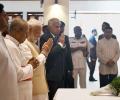
"My heart goes out to the families of the victims and the injured," Modi said.

Seven persons had been arrested in connection with the blasts.

President Maithripala Sirisena has issued a gazette notice banning three Islamic extremist organisations, including National Thowheeth Jama'ath that was blamed for the Easter bombings.

The National Tawheed Jamath is suspected of plotting the deadly Easter blasts.

On this day last year, ICC Anti-Corruption council officer Steve Richardson chose to eat breakfast in the executive lounge on the ninth floor of Cinnamon Grand instead of heading down to restaurant, a decision that saved him from the Easter Bombings. Richardson, who was in the country along with his colleagues to investigate corruption charges against Sri Lanka Cricket (SLC), was staying on the ninth floor of the hotel in Colombo, one of the six locations where bombs went off in a series of blasts, killing and injuring hundreds of people across the country.

'The ban is to ensure national security... No one should obscure their faces to make identification difficult,' Sirisena's office said in a statement.

The Pakistan under-19 side, captained by Rohail Nazir, was scheduled to arrive in Sri Lanka on April 30 to play two four-day matches, followed by three one-dayers.

'We believe that one of the suicide bombers studied in the UK and maybe later on did his post-graduate in Australia, before coming back to settle in Sri Lanka'
The details of the attackers and their relatives linked to the bombings was released by the police on Wednesday.

National flags were lowered and people bowed their heads as the silence began at 8:30 am local time, the time the first of the attacks occurred on Sunday.

President Maithripala Sirisena said Friday that over 130 suspects linked to the Islamic State terror group have been operating in the country.
'The residual historical hostility against India was certainly a factor,' says Colonel Anil A Athale (retd).

The names of both Maregowda and Puttaraju had figured in the list of missing Janata Dal-Secular workers tweeted by Chief Minister H D Kumaraswamy on Monday.

'India has given assistance that we required, otherwise we would not have been able to survive this far.'

The curfew was imposed on Sunday after a group of miscreants carrying swords attacked some people travelling on a three-wheeler in Porathota area of the town. The vehicle was set on fire.
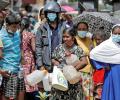
New Delhi has a chance to rid itself of its image as the bully in the subcontinent by helping a neighbour tackle problems that India, for once, has no role in creating. It should grab the opportunity with both hands, suggests Aditi Phadnis.
Sri Lankan cricketer Dasun Shanaka revisited the Easter Sunday horror, the serial blasts that took place in the country on Sunday, leaving almost 300 people dead and more than 500 injured.
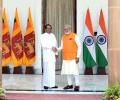
In the aftermath of the Easter Sunday terrorist attacks, allegations have been made that the Muslim militants in Sri Lanka draw sustenance from India. An overarching impression is being created that the ISIS is gaining ground in India, points out Ambassador M K Bhadrakumar.

The security forces continue their hunt for members of the local terror group National Thowheeth Jamath which was behind the deadly Easter Sunday bombings in which 253 people were killed and over 500 injured.
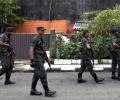
The NIA had alerted the island nation that ISIS terrorists were planning to carry out strikes there.
A Sri Lankan court on Friday named former president Maithripala Sirisena as a suspect in the 2019 Easter bombings in which 270 people, including 11 Indians, were killed.

-- Seven suicide bombers believed to be members of an Islamist extremist group carried out the series of explosions. -- Police have so far arrested 24 people - mostly members of an Islamist extremist group - in connection with the blasts

The suspicious van was wanted over the terror attacks and was taken into custody at Sungavila.

'What happened last Sunday is a great tragedy, an insult to humanity'

The Pahalgam massacre highlights the evolution of terrorism into a multi-domain challenge. India's response must similarly evolve -- from tactical retaliation to comprehensive strategic deterrence. To establish a credible and sustained deterrent, India must also carry out continuous kinetic operations, both overt and covert, suggest Sakshit Raina and Rahul Mishra. To establish a credible and sustained deterrent, India must also carry out continuous kinetic operations, both overt and covert, suggest Sakshit Raina & Rahul Mishra.

The PM said the government knew that Sri Lankan nationals who joined the Islamic State had returned, but they could not be arrested as joining a foreign terrorist organisation is not against the law in the island nation.
In another tweet, Akhtar said they expect reciprocation from Sri Lanka.

The commander said that by looking at the pattern of operation and the places that the suspects travelled, there has to be some outside involvement of some leadership or instructions.
The blockade of Facebook and WhatsApp has been imposed from mid-night following violent incidents between the minority Muslim and majority Sinhalese communities, officials said.
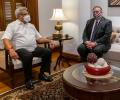
Pompeo, who became the Trump administration's highest ranking official to visit Sri Lanka, said that the US and Sri Lanka shared a vision for democracy to build a relationship and the "freedom to hold democratic elections".
